If someone has mentioned a damp proof course injection pump during a survey or quotation, the first thing to know is this: it is only one part of a proper damp treatment system. The pump itself does not solve damp. It is simply the tool used to introduce a damp proofing cream or fluid into the wall at the correct depth and pressure, so a new chemical damp proof course can form where the original barrier has failed or is missing.
That distinction matters. We regularly meet property owners who have been told they need “injection” without a clear explanation of why, whether rising damp has actually been confirmed, or what reinstatement work will be needed afterwards. In practice, a good result depends far more on diagnosis, wall condition, application method and follow-on plastering than on the pump alone.
What is a damp proof course injection pump?
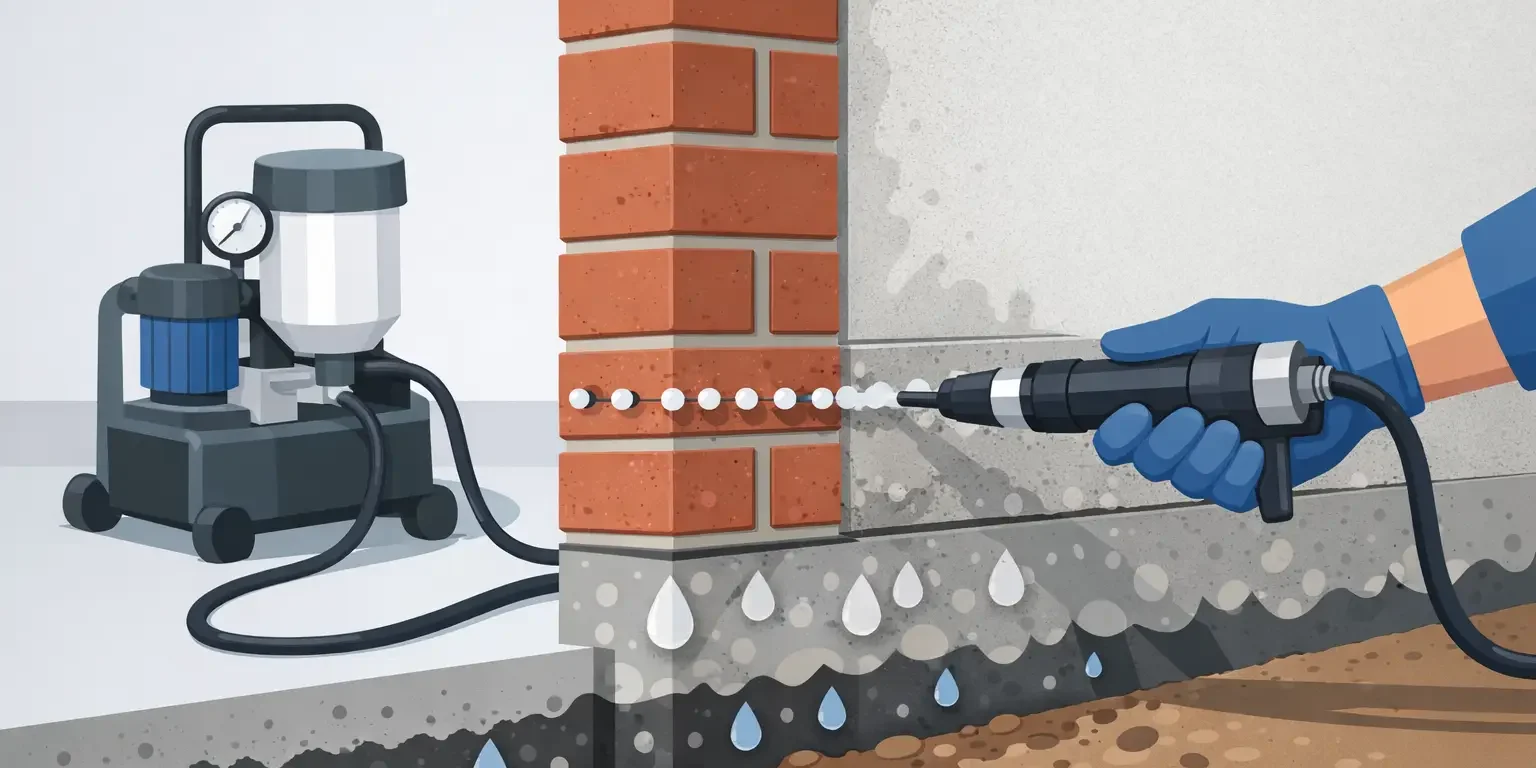
A damp proof course injection pump is a specialist applicator used to inject damp proofing material into masonry walls. In most remedial work, holes are drilled along the mortar bed at a set spacing, and the pump delivers the treatment into those holes so it can disperse through the capillaries of the masonry and form a moisture-resistant barrier.
Some systems are designed for creams, while others are used for fluid-based products. The choice depends on the product specification, the construction of the wall and the installer’s method statement. Solid brick, random stone, cavity walls and rubble-filled walls all behave differently, which is why the same approach is not suitable for every property.
For homeowners, the useful point is straightforward: the pump is there to apply the treatment consistently. It is not a shortcut and it is not a substitute for proper survey work.
Why the damp proof course injection pump matters
A chemical damp proof course needs to be installed at the right level and in the right quantity. If the treatment is under-applied, poorly distributed or injected into unsuitable masonry without adjustment to the method, the new barrier may be patchy. That can leave moisture paths in the wall and lead to disappointing results.
Using a damp proof course injection pump gives the installer better control over delivery, particularly where the product requires measured pressure or volume. It can also help with deeper saturation in difficult masonry, although that does not remove the need to assess wall build-up first.
There is a trade-off here. Pump injection can be very effective in the right circumstances, but older buildings often need more thought. Walls with voids, friable mortar, heavy salt contamination or mixed stone construction may require adapted drilling patterns, a different product, or in some cases a completely different remedial approach.
Pump injection versus cartridge application
Not all chemical damp proof courses are installed with a powered pump. Some creams are applied by cartridge or manual applicator. On straightforward brickwork, this can work perfectly well when the product and hole pattern are correct.
A pump tends to come into its own where larger areas are being treated, where a fluid system is specified, or where consistency of application is especially important. That said, one method is not automatically better than the other in every situation. The best option depends on the wall, the chosen system and the standards of the contractor carrying out the work.
When is injection actually appropriate?
This is where experience matters most. A damp proof course injection pump is used when rising damp has been properly identified and a remedial damp proof course is the appropriate solution. It is not the answer for every damp problem.
Condensation, penetrating damp, leaking plumbing, raised external ground levels, bridging by render or plaster, blocked sub-floor ventilation and defective rainwater goods can all produce symptoms that look similar to rising damp. Tidemarks, damaged skirtings and peeling finishes are not enough on their own to justify chemical treatment.
Before any drilling starts, the property should be assessed carefully. That means looking at moisture patterns, construction type, internal and external ground levels, ventilation, existing plaster condition and any defects that may be introducing water into the building. In many cases, more than one issue is present at the same time.
Common situations where injection may be recommended
Remedial injection is often suitable where an original damp proof course has deteriorated, where there is no effective damp proof course in an older property, or where localised sections of wall have lost their resistance to ground moisture. It can also form part of a wider repair scheme after bridging issues have been corrected.
However, if external paths, flower beds or render are sitting above internal floor level, injecting a wall without addressing those details first is unlikely to deliver a lasting result. Good damp treatment is usually about removing causes as well as installing barriers.
How the installation process usually works
Once rising damp has been confirmed and the right system chosen, the installer drills a series of holes along the selected mortar course, usually at low level and in a continuous line. The spacing, depth and diameter are determined by the wall thickness and the manufacturer’s specification.
The damp proof course injection pump is then used to introduce the treatment into each hole. In solid walls, the aim is to create a continuous treated zone across the full thickness of the masonry. In cavity construction, both leaves may need separate consideration. In thicker or irregular walls, additional drilling from both sides may be required.
After the injection stage, contaminated plaster often has to be removed and replaced with a suitable renovating plaster or replastering specification. This part is frequently overlooked by property owners, yet it has a major effect on how successful the job appears afterwards. Even when moisture movement has been controlled, hygroscopic salts in old plaster can continue to attract moisture from the air and cause persistent staining or damp readings.
The real issue is not the pump – it is the system
It is easy to focus on the equipment because it sounds technical. In reality, the key questions are whether the diagnosis is correct, whether the chosen treatment matches the wall construction, and whether the reinstatement works are being done properly.
A competent contractor should be able to explain why injection is being recommended, what product is being used, how the wall type affects the application, whether contaminated plaster needs removing, and what drying and redecoration times to expect. If those points are vague, the presence of specialist equipment should not be taken as reassurance on its own.
This is especially true in older properties across Devon and Cornwall, where mixed masonry and historic alterations are common. Buildings of that type often need practical judgement rather than a one-size-fits-all specification.
What property owners should ask before agreeing to treatment
If a contractor recommends a damp proof course injection pump as part of the work, ask what evidence supports rising damp as the diagnosis. Ask how they have ruled out condensation, penetrating damp and bridging. Ask what wall construction they have identified and whether the injection method changes because of it.
It is also sensible to ask what plastering or making-good is included, who carries it out, and whether the contractor is responsible for the full process from treatment through to reinstatement. That joined-up service tends to reduce confusion and delays, particularly if the property is being prepared for sale, let, insurance work or reoccupation.
For many clients, that clarity is just as important as the technical treatment itself. A survey-led approach, backed by trained staff and clear reporting, usually gives far more confidence than a quick quotation based only on visible staining.
Choosing the right contractor for injection work
The best contractor is not simply the one who owns the pump. You want a company that understands damp behaviour in buildings, can distinguish between moisture sources, and has the practical building experience to deal with associated works properly.
That includes drilling and injection, of course, but also plaster removal, salt-resistant replastering, skirting replacement, joinery making-good and any external corrective work needed to prevent bridging. When one contractor can manage diagnosis, treatment and reinstatement, the process is usually more straightforward and accountability is clearer.
That is one reason homeowners, landlords and property professionals often prefer specialist preservation companies with in-house remedial capability rather than trying to coordinate multiple trades separately.
A damp proof course injection pump is a useful piece of professional equipment, but it is only valuable when it sits within a properly considered remedial scheme. If you are dealing with suspected rising damp, the right starting point is not the pump – it is a careful survey, a clear explanation, and treatment that fits the building in front of you.